How to Vet a Real Estate Syndication Sponsor Before You Invest
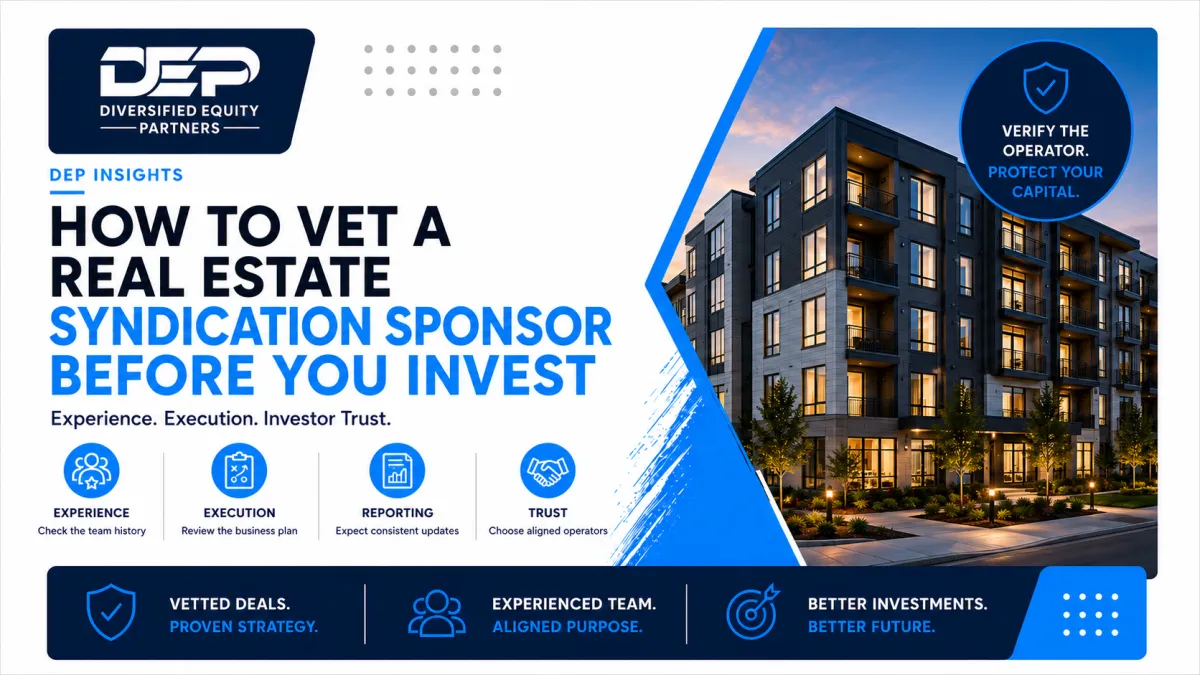
How to Vet a Real Estate Syndication Sponsor Before You Invest
Transparency and communication from your operator are key indicators of trustworthiness.
When buying or selling a home, most people don't hire the first real estate agent they meet.
They research the agent, look at their experience, ask questions, read reviews, and make sure that person understands what they're trying to accomplish.
Why?
Because that agent will be representing them during an important financial decision.
Investing in a real estate syndication deserves the same level of due diligence—if not more.
Investors often spend significant time analyzing the property, market, projected returns, and business plan. Those things matter.
But there's another question that deserves just as much attention:
Who is actually responsible for executing the plan?
The sponsor, or operator, is responsible for overseeing many of the major decisions surrounding the investment.
That's why at Diversified Equity Partners, we encourage investors to evaluate the people behind the deal, not just the numbers presented in the investment deck.
Why the Operator Matters
Projected returns are based on assumptions.
Actually achieving the business plan depends heavily on execution.
The operating team may be responsible for acquisitions, financing, construction oversight, property management, asset management, investor communication, and ultimately determining when and how the property is sold or refinanced.
Before investing, understand who these people are.
What have they done before?
What role does each team member have?
How have they handled difficult situations?
And perhaps most importantly:
How do they communicate when things don't go according to plan?
Here are six areas I would evaluate before investing with a real estate sponsor.
1. What Is Their Investment Philosophy?
Start by understanding how the sponsor thinks about investing.
Are they aggressive or conservative?
Do they prioritize cash flow, appreciation, value-add opportunities, development, or some combination?
How much leverage are they comfortable using?
What types of risks are they willing to accept?
Your philosophy doesn't have to match the operator's perfectly, but you should understand what you're signing up for.
If you're looking for a conservative long-term investment and the operator specializes in highly leveraged development deals, there may be a mismatch.
Alignment matters.
2. What Does the Company Actually Invest In?
Understand the operator's area of expertise.
What asset classes do they invest in?
Which markets?
What size properties?
What business plans?
Someone who has built their experience operating multifamily properties may have a very different skill set than someone specializing in ground-up development, self-storage, industrial property, or short-term rentals.
There's nothing wrong with expanding into new markets or strategies.
But if a team is doing something outside its historical experience, understand who on the team provides that expertise and how responsibilities are divided.
3. What Is Their Track Record and Their Actual Role?
Track record matters, but don't stop at the number of units or total transaction volume displayed on a website.
Ask deeper questions.
What was the operator's actual role in those deals?
Did they find the property?
Underwrite it?
Guarantee the loan?
Raise capital?
Manage construction?
Handle asset management?
Oversee property management?
There is a major difference between participating in a transaction and being responsible for operating it.
Also ask about properties that didn't perform according to the original plan.
Experienced operators will eventually encounter challenges.
The goal isn't to find someone with a perfect history.
The goal is to understand how they respond when problems occur.
4. How Is the Team Structured?
Real estate syndications require multiple skill sets.
You should understand who is responsible for:
Acquisitions
Underwriting
Financing
Construction
Property management
Asset management
Accounting
Investor relations
The larger or more complicated the investment, the more important organizational capacity becomes.
Ask what would happen if a key member of the team became unavailable.
Is there redundancy?
Who can step into important responsibilities?
Does the company have systems and processes beyond one individual?
You're not simply investing in a property.
You're investing in the team's ability to operate a business.
5. Are Their Interests Aligned With Investors?
Ask how the sponsorship team gets compensated.
Review acquisition fees, asset-management fees, construction-management fees, refinance fees, disposition fees, promote structures, and any other compensation disclosed in the offering documents.
Fees aren't automatically negative.
Operating a real estate investment requires people, infrastructure, and expertise.
The important question is whether the compensation structure is clearly disclosed and reasonably aligned with successful execution of the business plan.
You can also ask whether members of the sponsorship team are personally investing in the opportunity.
Sponsor investment can create additional alignment, although the amount and structure will vary between deals.
6. How Do They Communicate?
This is one of the biggest areas investors overlook.
Pay attention to communication before you invest.
Does the team answer your questions directly?
Do they explain both the opportunity and the risks?
Are they willing to say, “I don't know, but I'll find out”?
Do they provide regular updates on existing investments?
Can they discuss challenges without immediately becoming defensive?
Communication is especially important when a property isn't performing exactly as projected.
You don't want to discover an operator's communication style after you've already invested.
Red Flags Worth Investigating
Not every unusual situation means you should walk away from an investment.
But certain things should cause you to ask more questions.
Unclear Track Record
Be cautious when someone discusses large numbers of units or transaction volume but can't clearly explain their responsibilities in those investments.
Heavy Dependence on Aggressive Assumptions
Pay attention if the investment requires strong rent growth, a favorable refinance, aggressive appreciation, or multiple assumptions working perfectly to generate the projected return.
No Meaningful Downside Discussion
Every investment carries risk.
If a presentation spends 45 minutes discussing potential returns and almost no time explaining what could go wrong, keep asking questions.
Unclear Distributions
Understand exactly where distributions are coming from.
Are they generated by property operations?
Are they proceeds from a refinance?
Are they returning a portion of investor capital?
The source matters.
No Clear Team Responsibilities
You should understand who is responsible for executing each major component of the business plan.
Avoiding Questions About Existing Properties
Ask about current investments—not just successful exits.
How are existing properties performing?
What challenges are they facing?
Constantly Changing Strategies
Expansion can be healthy, but frequent changes in asset class, market, or strategy without an experienced team supporting those changes deserve additional scrutiny.
Pressure to Invest Quickly
Limited investment capacity can be real.
But you should never feel pressured to skip your own due diligence just because an opportunity may fill.
Everything Has Always Gone Perfectly
Real estate rarely works that way.
Interest rates change.
Contractors miss deadlines.
Insurance increases.
Occupancy changes.
Unexpected repairs happen.
The ability to explain previous challenges and what was learned from them can tell you more than another successful deal announcement.
Dodging Direct Questions
You should feel comfortable asking difficult questions.
An operator doesn't have to tell you everything you want to hear.
But they should be willing to have the conversation.
Final Thoughts
When evaluating a real estate syndication, it's easy to become focused on the projected preferred return, IRR, equity multiple, or cash flow.
But those numbers are projections.
People execute the business plan.
Before investing, take time to understand the operator's experience, responsibilities, investment philosophy, team structure, communication style, compensation, existing portfolio, and approach to risk.
Don't be afraid to ask direct questions.
And don't evaluate only what went right.
Ask what went wrong and how the team responded.
At Diversified Equity Partners, we believe investor education should happen before capital is committed.
Vet the people just as carefully as you vet the property.